
26 March 2025
Ridging is a widely used technique, especially in horticulture, but not only. It consists of transferring a certain amount of soil from the inter-row to the base of the plant. It is a traditional practice that is generally widely used in home gardens-but also in larger agricultural fields, because of the many benefits it brings to soils for specific crops.
Each soil, in fact, has particular and unique characteristics. The goal of the farmer and horticulturist is to understand what its properties are, to indulge them, and to direct them toward developing the most suitable crop. Some operations, such as, but not limited to, ridging, are designed precisely to make the most of the soil's characteristics and make it ideal for the development of the culture.
In this article we will delve precisely into the operation of ridging.
Ridging is an operation that involves bringing soil to the base of plants. A certain amount of soil is then piled at the foot of the seedling so that its basal part is covered. This is done for several purposes: to protect against frost, to aid irrigation (thanks to the open furrows in the inter-row of horticultural crops), to allow better control of plant health, and to encourage whitening.
It is also often done similarly to mulching in managing smaller weeds, which are covered by the soil - but the effect is still limited in time. This is not to be confused with weeding, which is done to remove surface crust and weeds, while ridging is a kind of “mechanical weeding” that helps give soil (and thus nutrients, moisture, temperature) to crops.
Ridging is a widely used practice in fields and farms but is particularly valuable for the horticulture sector. Useful for many crops, it is most effective in potato cultivation. But it also proves useful for growing other vegetables, such as:
For all the types of vegetables we have seen (and particularly the potato), ridging can bring several benefits. So much so that, depending on the intended objective, ridging itself takes on specific designations:
The best time to tamp is when the soil is temperate, neither too wet nor too dry (we are talking about a water content around 40-50%). As you can easily guess, it is best to tamp during the middle seasons, spring and fall.
In particular, fall ridging has a preventive function to protect the plant against the onset of winter and the drop in temperature.
Spring ridging, on the other hand, has a qualitative function, aiming to improve and increase the productivity and quality of the crop.
In general, it is better to do the ridging shortly after the seedling is born, because the operation becomes more complex and articulated when the plant is mature (care must be taken not to ruin the leaves and the superficial roots); care must also be taken to tamp the right amount of soil: if it is too little, the desired effect will not be achieved; if it is too much, it may cause a slowdown in development.
Cosmeco designs and manufactures a complete range of agricultural machines that are essential for the best possible preparation of the soil for cultivation, such as bedformers, ditchers, agricultural ridgers and adjustable film layer for low tunnels. These machines are the ideal solution for a wide range of operations to be carried out both in the open field, for larger farms and for horticultural operations.
There are also agricultural ridgers specifically designed for small tunnels: the adjustable ridger is specifically designed to take soil from the inter-row of tunnels and greenhouses and then place it against the edges of the covering film, fixing the basal part of the film to the ground.
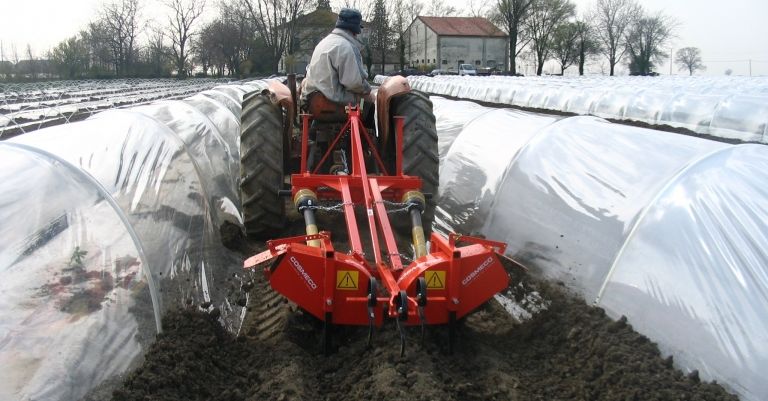
Among the various types of agricultural and horticultural machinery, the company designs and builds mulch layer and bedformer machines. Cosmeco also specializes in customizing its equipment according to the customer's needs, thus offering the possibility of working according to personal needs.
A type of "preventative" and more durable tillage, because it allows ideal seedbed preparation, is bedforming. And Cosmeco's bedformers in particular are adjustable and suitable for all types of soil. They help to create compact ridges or seedbeds, which are useful for plant development, and allow the soil in the ridge to be perfectly broken up and compacted, ensuring optimal germination and growth of all types of crops.
If you would like more information about Cosmeco's soil preparation equipment for your crop, please contact us by filling out the form in the Contact Us section. We will get back to you as soon as possible!
Need more information about one of our products or need a tailor-made quote?
Don't hesitate to contact us and we will get back to you as soon as possible.